10 Signs Your Hospital Needs a Hospital Management System
It's 8:15 AM on a Monday morning.
The waiting area is already filling up. A patient is asking for her test results. The pharmacy is trying to confirm a prescription. The accounts department is handling a billing dispute. Meanwhile, a nurse is searching for a patient's file that was last seen "somewhere in records."
Sound familiar?
For many hospitals, this isn't an unusual day, it's business as usual.
Healthcare professionals are trained to save lives, provide care, and improve patient outcomes. Yet many hospitals still rely on manual processes that create delays, increase stress, and make daily operations harder than they need to be.
The truth is that operational inefficiencies don't just affect staff. They affect patients too.
If you recognize any of the signs below, it may be time to consider a Hospital Management System like Clinika HMS.
1. Finding Patient Records Feels Like a Treasure Hunt
Mrs. Johnson arrives for a follow-up appointment.
The doctor asks for her previous records.
The nurse checks one cabinet.
Then another.
Someone remembers that the file was sent to billing last week.
Ten minutes later, everyone is still searching.
The patient waits.
The doctor waits.
The schedule falls behind.
When patient information exists in paper files, spreadsheets, and multiple locations, retrieving records becomes a daily challenge.
A Hospital Management System stores patient information in one secure location, allowing authorized staff to access records in seconds instead of minutes.
2. Your Reception Area Is Always Crowded
Nobody likes waiting.
Patients become frustrated when registration takes too long, consultations start late, or billing queues stretch across the waiting room.
What many hospitals don't realize is that these delays are often symptoms of disconnected systems.
When registration, consultation, laboratory, pharmacy, and billing departments operate separately, patients spend more time moving between desks than receiving care.
A Hospital Management System connects these departments and streamlines patient flow from arrival to discharge.
3. Billing Mistakes Are Becoming Too Common
Imagine a patient receives a bill that includes charges for services they never received.
Or worse, your hospital forgets to bill for services that were actually provided.
Both situations cost money.
One damages patient trust.
The other damages your revenue.
Manual billing systems leave too much room for human error.
An HMS automates calculations, tracks services rendered, and helps ensure accurate billing every time.
4. Essential Drugs Keep Going Out of Stock
A doctor prescribes medication.
The patient heads to the pharmacy.
Then comes the response nobody wants to hear:
"Sorry, we're out of stock."
Not because demand was unusually high.
Not because suppliers failed.
Simply because nobody realized inventory was running low.
Without proper inventory monitoring, stockouts become inevitable.
A Hospital Management System provides real-time inventory visibility, helping pharmacy teams reorder before shortages occur.
5. Important Decisions Are Based on Guesswork
A hospital administrator asks:
"How many patients did we see this month?"
The response?
"We'll have to check."
Then another question:
"Which department generated the highest revenue?"
Again:
"We'll need some time to compile the figures."
If obtaining basic operational information takes hours or days, decision-making becomes difficult.
Modern hospitals need real-time insights.
An HMS provides instant reports on patient volume, revenue, inventory levels, staff performance, and other critical metrics.
6. Staff Spend More Time Managing Paper Than Caring for Patients
Doctors didn't enter medicine to fill out endless forms.
Nurses didn't train for years to spend half their shifts searching for documents.
Yet in many hospitals, administrative work consumes valuable clinical time.
Every minute spent on paperwork is a minute not spent caring for patients.
A Hospital Management System automates routine processes, reducing administrative burdens and allowing healthcare professionals to focus on care delivery.
7. Managing HMO and Insurance Claims Feels Like a Battle
Missing documents.
Delayed approvals.
Rejected claims.
Countless phone calls.
For many hospitals, managing insurance and HMO claims is one of the most frustrating parts of healthcare administration.
A Hospital Management System helps organize patient records, treatment information, and billing data, making claims management faster and more accurate.
8. Departments Don't Always Seem to Be on the Same Page
The doctor updates a patient's treatment plan.
The pharmacy hasn't seen it.
Billing doesn't have the latest information.
The laboratory is waiting for clarification.
Suddenly, what should have been a simple process becomes a chain of confusion.
When departments work with different information, mistakes become more likely.
An integrated Hospital Management System keeps everyone connected and working from the same data.
9. Your Hospital Is Growing Faster Than Your Processes
Growth is exciting.
More patients.
More services.
More staff.
More opportunities.
But growth also exposes weaknesses in manual systems.
The processes that worked when you saw 30 patients per day may not work when you're seeing 150.
A Hospital Management System provides the structure and scalability needed to support long-term growth.
10. Every Day Feels Like Crisis Management
You start the day planning to focus on strategy.
Instead, you're dealing with:
- Missing files
- Drug shortages
- Billing complaints
- Scheduling conflicts
- Staff frustrations
By the end of the day, you've spent more time solving preventable problems than improving your hospital.
If this sounds familiar, the issue may not be your people.
It may be your systems.
It's Time to Work Smarter
The best hospitals aren't necessarily the ones with the biggest buildings or the most staff.
They're the ones with systems that allow their teams to work efficiently and deliver exceptional patient care.
That's where Clinika HMS comes in.
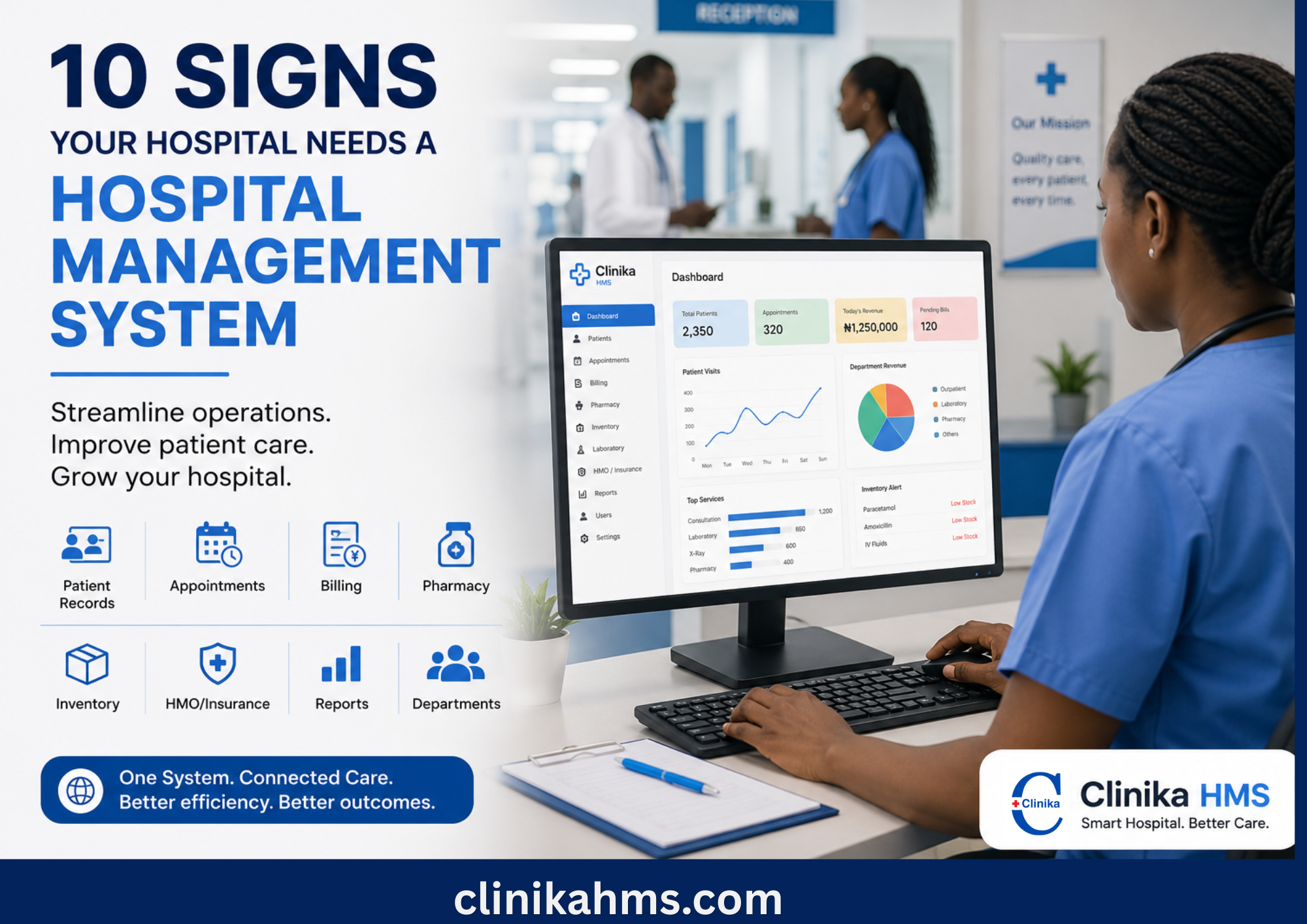
Clinika HMS helps hospitals manage patient records, appointments, billing, pharmacy operations, inventory, reporting, and much more from a single platform.
Instead of spending your day chasing files, resolving billing issues, or reacting to stock shortages, you can focus on what truly matters, providing quality healthcare.
Ready to transform the way your hospital operates?
Visit the Clinika website today (clinikahms.com) and discover how Clinika HMS can help your hospital become more efficient, organized, and patient-focused.