AI Is No Longer “A Tech Person Thing.” And That Matters
A few years ago, if you heard someone say they were learning Artificial Intelligence, you probably imagined a programmer sitting in front of six computer screens, writing complicated code and speaking in terms nobody else understood.
Now?
Your colleague is using AI to draft emails.
A teacher is using it to prepare lesson materials.
A business owner is using it to write social media content.
A student is using it to understand difficult topics.
An accountant is using it to analyse data.
A doctor can use AI tools to organize information and support research.
A lawyer can use it to review and summarize documents.
A designer can use it to generate ideas.
And someone who has never written a line of code can use AI to build something surprisingly useful.
AI has left the “tech department.”
It is now becoming a workplace skill.
And whether you are excited about it or slightly worried about it, one thing is becoming difficult to ignore:
Knowing how to use AI is becoming useful in almost every sector.
“But I’m Not a Tech Person.”
This is probably one of the biggest misconceptions about AI.
You don't have to become a programmer.
You don't need to understand how a large language model was trained.
You don't need to build robots.
You don't need to become an AI engineer.
Think about Microsoft Word.
Most people who use Word don't know how Microsoft built it.
They simply know how to create a document, format it, edit it, and get their work done.
The same principle applies to many AI tools.
The important question isn't:
“Can I build AI?”
It's increasingly:
“Can I use AI effectively to solve problems and get work done?”
AI Is Becoming Like the Calculator
Imagine telling an accountant:
“I don't use calculators. Real accountants should calculate everything manually.”
That might sound admirable for about five minutes.
Then you realize the accountant is spending two hours doing calculations that a calculator could handle in seconds.
Technology doesn't necessarily remove the need for expertise.
It can help people apply their expertise more efficiently.
AI is heading in a similar direction.
The teacher still needs to understand teaching.
The doctor still needs medical knowledge.
The lawyer still needs legal knowledge.
The marketer still needs marketing knowledge.
The accountant still needs accounting knowledge.
But AI can help them work with information, generate ideas, automate repetitive tasks, analyse content, and get certain jobs done faster.
The professional brings the expertise. AI can become another tool in the toolbox.
And Here Is Where It Gets Interesting...
AI isn't only changing what people do.
It is changing how quickly they can do it.
Imagine a business owner who needs ten social media ideas.
Instead of staring at a blank screen for an hour, AI can help generate a starting point.
A researcher has a pile of information to organize.
AI can help summarize and structure it.
A student doesn't understand a difficult concept.
AI can explain it in simpler language and provide examples.
A company needs a first draft of a proposal.
AI can help create a starting structure.
A manager needs to turn meeting notes into action points.
AI can help organize them.
A designer needs five concepts before choosing one.
AI can help brainstorm.
The person still needs to think, check, edit and make decisions.
But they don't always have to start from zero.
And that is powerful.
The Real Skill Isn't Just “Using ChatGPT”
This is another important point.
AI skills go beyond knowing how to open an AI chatbot and type:
“Write something for me.”
The real skill is learning how to communicate with AI effectively.
How do you give it context?
How do you explain what you actually need?
How do you ask better questions?
How do you provide examples?
How do you get it to improve a response?
How do you verify the information it gives you?
How do you protect confidential information?
How do you combine AI with Excel, Canva, Word, research tools, coding tools and other software?
That is where AI literacy comes in.
And just like computer literacy became important across many jobs, AI literacy is becoming increasingly relevant across many industries.
Every Sector Has Something to Gain
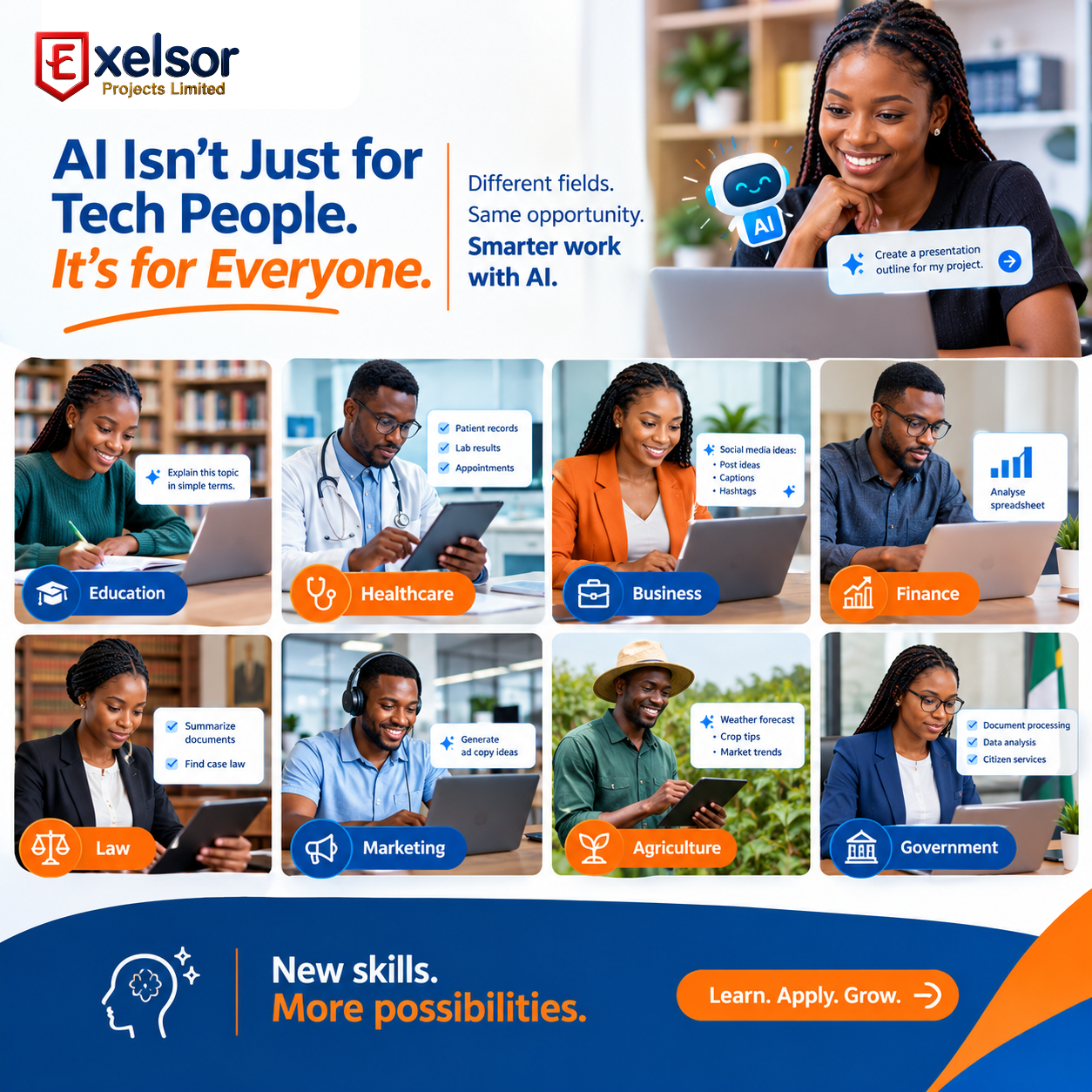
Education
Teachers can use AI to brainstorm lesson activities, create practice questions, develop learning materials, and adapt explanations for different learning levels.
Students can use it as a learning assistant, not as a replacement for learning.
Because copying an AI answer without understanding it isn't education.
It's just outsourcing your brain.
Business
Business owners can use AI for content ideas, customer communication, market research, proposals, planning, data analysis, and workflow automation.
Small businesses, especially, can benefit from tools that help them do more with limited resources.
Healthcare
AI can support areas such as research, documentation, information organization, and administrative workflows.
Of course, healthcare professionals still need professional judgment, proper procedures, and appropriate verification.
AI should support expertise, not replace it.
Finance and Accounting
From analysing spreadsheets to identifying patterns, preparing summaries, and automating repetitive tasks, AI can help finance professionals spend less time on certain routine activities and more time on analysis and decision-making.
Law
Legal professionals can use AI for tasks such as document review, summarization, research assistance, and drafting.
But legal accuracy matters.
AI-generated information still needs professional review.
Marketing
This one is obvious.
Content ideas.
Campaign brainstorming.
Customer research.
Copywriting.
Visual concepts.
Email drafts.
Social media planning.
AI has become another tool in the marketer's toolbox.
Agriculture
AI can support areas such as data analysis, farm monitoring, forecasting, and decision support.
As technology becomes more accessible, its application will continue to expand beyond traditional office jobs.
Government and Public Administration
There are opportunities for AI to assist with document processing, data analysis, citizen services, research and administrative workflows.
The goal should be better service delivery, with appropriate privacy, security and human oversight.
So, Who Should Learn AI?
The short answer?
Almost everybody.
Not necessarily because everyone needs to become an AI expert.
But because almost everyone will encounter AI in their work, business, education or daily life.
If you're a student, learn it.
If you're a teacher, explore it.
If you're running a business, understand it.
If you're a professional, experiment with it.
If you're a researcher, learn how to use it responsibly.
If you're a creative, discover what it can add to your workflow.
If you're already working, don't wait until your workplace introduces an AI tool and you're staring at the screen wondering:
“So... what am I supposed to do with this?” ????
Start now.
But Don't Just Learn the Tools. Learn the Thinking.
AI tools will change.
The tool everyone is talking about today may not be the tool everyone uses next year.
New models will appear.
New features will arrive.
Some tools will disappear.
Others will become better.
That's why learning AI thinking and practical AI skills is more valuable than memorizing one particular tool.
Learn how to:
Identify tasks AI can help with
Write effective prompts
Give AI useful context
Check and verify AI-generated information
Improve AI outputs
Combine multiple AI tools
Automate repetitive tasks
Protect sensitive information
Use AI ethically and responsibly
Those skills can travel with you even when the tools change.
The Biggest Mistake May Be Waiting
You don't have to become an AI expert this week.
Start small.
Take one task you do regularly.
Ask yourself:
“Could AI help me do this faster, better or differently?”
Try it.
Test the result.
Check it.
Improve your approach.
Then try another task.
That's how you build the skill.
Because the future of AI isn't simply about people who know how to build artificial intelligence.
It is also about people who know how to work intelligently with it.
And that includes teachers, students, doctors, lawyers, accountants, entrepreneurs, administrators, researchers, creatives, engineers, farmers, civil servants and professionals across almost every field.
You don't need to become a tech person.
You just need to become comfortable enough with technology to recognize when it can help you.
The question is no longer simply:
“Will AI change my industry?”
A more useful question is:
“How can I learn to use it before I am forced to catch up?”
Start Learning. Start Experimenting. Start Using AI.
At Exelsor Training Academy, we believe technology should be practical and accessible.
Whether you're a student, professional, business owner, or someone simply looking to upgrade your digital skills, learning how to use modern AI tools can give you another valuable skill for work and everyday life.
Don't wait until AI becomes part of your job description.
Start learning how to make it part of your toolbox.