AI vs Human Intelligence: Will AI Replace Jobs?
If you have spent time online recently, you would have heard people talking about artificial intelligence (AI). Some people are excited about it, while others are worried. One of the biggest concerns is whether AI will eventually take over human jobs.
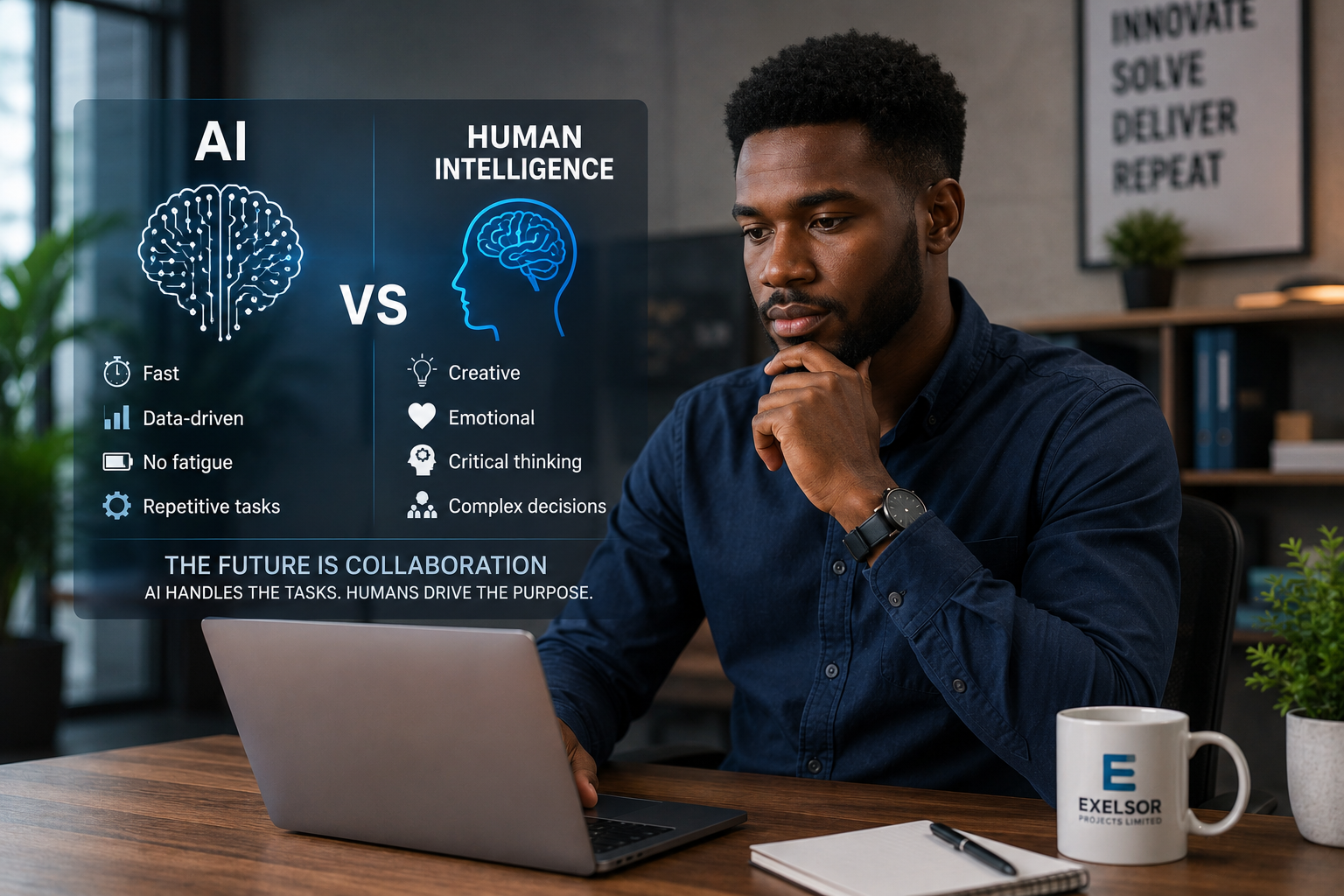
It's easy to understand why people are asking this question. AI can now write articles, create images, answer customer questions, analyze data, generate computer code, and even help businesses make decisions. Tasks that once took hours can now be completed in minutes with the help of AI tools.
As impressive as this sounds, it has left many professionals wondering where they fit into the future. Will companies eventually replace workers with machines? Will AI make certain careers obsolete? Or will it simply change the way we work?
The truth is that AI is changing the workplace, but not necessarily in the way many people imagine.
To understand what is really happening, we need to look at the difference between artificial intelligence and human intelligence.
AI is incredibly good at processing information. It can analyze large amounts of data, identify patterns, and perform repetitive tasks faster than any human could. It doesn't get tired, distracted, or need breaks. This makes it an excellent tool for handling routine work.
Human intelligence, however, is much more than speed and efficiency. People have the ability to think creatively, understand emotions, build relationships, solve unexpected problems, and make decisions based on experience and judgment. These are qualities that machines still struggle to replicate.
Think about a teacher inspiring students, a doctor comforting a worried patient, a manager leading a team through a difficult challenge, or an entrepreneur spotting an opportunity where others see a problem. These situations require empathy, creativity, intuition, and human connection—qualities that cannot simply be programmed into a machine.
This is why many experts believe AI will not replace humans entirely. Instead, it will change how humans work.
In many industries, AI is already taking over repetitive tasks. Customer service chatbots answer common questions. Accounting software processes transactions automatically. Inventory management systems track stock levels in real time. Businesses are using AI to improve efficiency and reduce costs.
For workers whose jobs consist mainly of routine tasks, this shift may feel threatening. Some roles will undoubtedly change, and others may disappear over time. However, history shows that technology often creates new opportunities even as it transforms existing ones.
When computers became common in workplaces, many people feared they would eliminate jobs. Instead, they created entirely new careers that had never existed before. The same thing is happening with AI today.
New opportunities are emerging in fields such as AI development, cybersecurity, data analysis, digital marketing, automation, and technology consulting. Businesses need people who can understand, manage, and apply these technologies effectively.
Perhaps the most important thing to understand is that AI is not replacing entire professions as much as it is replacing specific tasks within those professions.
A doctor may use AI to analyze medical images, but patients still need a doctor's expertise and compassion. A lawyer may use AI to review documents, but clients still rely on human judgment and legal strategy. A marketer may use AI to generate content ideas, but successful campaigns still require creativity and a deep understanding of human behavior.
The future is not about humans competing against AI. It is about humans learning how to work alongside AI. Those who embrace technology, develop new skills, and learn how to use AI effectively will be in a stronger position than those who resist change. Just as computers became an essential workplace tool, AI is quickly becoming another tool that professionals can use to become more productive and valuable.
In the end, the question is not whether AI will replace jobs. The better question is this: Are we prepared to adapt to a world where AI is becoming part of everyday work? The individuals and businesses that answer "yes" will be the ones that thrive in the years ahead.