When Connectivity Fails, Clinika Keeps Healthcare Moving
It was 2:47 PM on a Tuesday when the internet at St. Grace Hospital suddenly went down.
There was no warning. No major equipment failure. No dramatic technical incident.
Just a fibre fault somewhere down the line, the kind of thing that happens a few times a year.
But for Mrs. Adaeze, the hospital administrator, it meant something much bigger.
It meant chaos.
At the front desk, staff could no longer access appointment schedules. In the emergency wing, a nurse needed to check a patient's allergy history but couldn't pull up the information.
At the billing counter, three transactions froze halfway through.
Patients waited.
Staff improvised.
Departments started making phone calls to one another, trying to find information that normally took only a few seconds to access.
By the time the connection returned two hours later, the network was back, but the disruption wasn't over.
The backlog took the rest of the day to clear.
For Mrs. Adaeze, that Tuesday became the last straw.
She had heard about Clinika, a hospital management system developed by Exelsor Projects Ltd, but she had always assumed it was simply another digital records system.
Then a colleague mentioned one detail that caught her attention:
Clinika can continue working even when the internet connection goes down.
That changed everything.
Three months later, St. Grace Hospital was running on Clinika.
And the difference wasn't just about having a new piece of software.
It was about how the hospital operated.
When a patient walks through the doors, the front desk can quickly access relevant information such as their personal details, previous visits, treatment history, and other medical records.
Appointments can be managed more efficiently, while billing and other administrative processes become easier to coordinate.
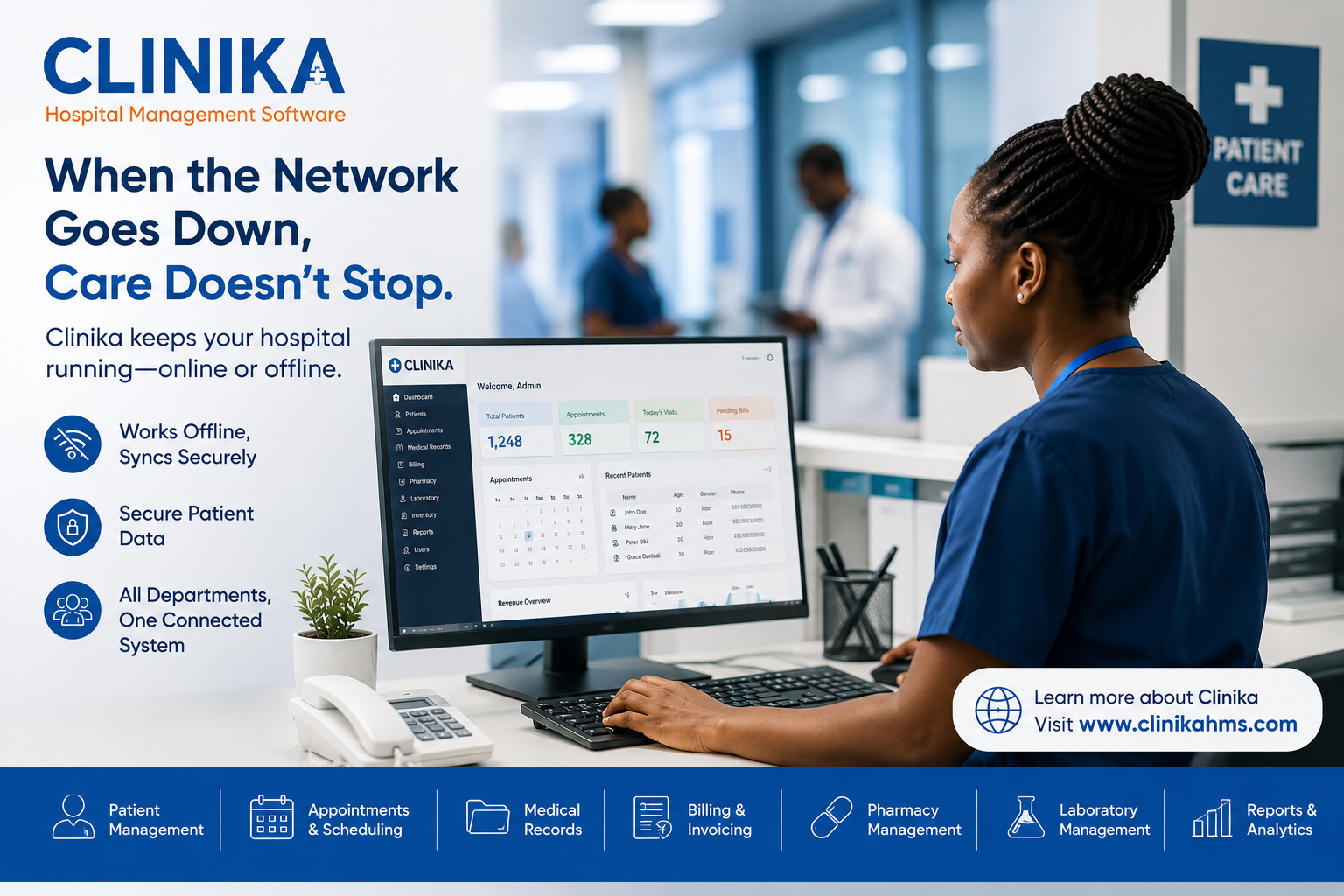
Clinika brings important hospital functions together in one platform, including patient management, appointments, medical records, billing, pharmacy, laboratory services, inventory, and reporting.
But perhaps the most important difference is what happens when the internet isn't available.
Instead of the entire workflow coming to a halt, staff can continue working with Clinika's offline version.
Once connectivity is available again, the hospital can return to its connected workflow.
The internet can go down. The hospital doesn't have to.
Mrs. Adaeze soon realized that the network outage had exposed a deeper problem.
The hospital wasn't struggling only because the internet had failed.
Different departments had been working in silos.
Records had one piece of the patient's story. Scheduling had another. Billing had its own information. Other departments had their own processes and records.
Everyone was working.
But they weren't always working from the same picture.
And in a hospital, that can create unnecessary delays.
Clinika brings these processes together through a centralized hospital management platform designed to help different departments work more efficiently.
From patient registration and appointments to billing, pharmacy, laboratory services, inventory, and administration, the goal is simple:
Make information easier to access and make hospital operations easier to manage.
A few weeks later, the same thing happened.
The network went down.
Same fibre line.
Same frustrating problem.
But this time, something was different.
The front desk continued checking patients in.
The nurse in the emergency wing accessed the information she needed.
Billing continued processing transactions.
Appointments didn't suddenly become inaccessible.
Patients didn't have to wait for the network to come back before the hospital could continue operating.
Mrs. Adaeze didn't even know there had been an outage until someone from IT mentioned it the following morning.
That was when she understood the real value of Clinika.
It wasn't simply about replacing files with digital records.
It wasn't about having another piece of hospital software.
It was about building a hospital workflow that could keep moving when unexpected problems occurred.
Technology should make healthcare operations more resilient, not create another point of failure.
A hospital cannot choose when a fibre cable will be damaged, when an internet provider will experience an outage, or when connectivity will become unstable.
But it can choose how prepared it is when those things happen.
Clinika is available as both a cloud-based and offline hospital management solution, helping healthcare facilities maintain operations even in environments where internet connectivity may be limited or unreliable.
Because when a patient needs care, the last thing anyone should have to say is:
"We can't access the system because the internet is down."
The next network outage may still be frustrating.
But with the right hospital management system, it doesn't have to bring the hospital to a standstill.
Is Your Hospital Ready for Its Next Network Outage?
If your hospital still depends entirely on an internet connection to access critical operational information, it may be time to rethink your system.
Clinika is designed to help hospitals, clinics, and healthcare centers manage their operations more efficiently with a flexible hospital management solution that supports both cloud-based and offline deployment.
Your hospital should keep running, even when the network doesn't.
Want to see how Clinika can transform the way your hospital manages patients, records, appointments, billing, pharmacy, laboratory services, and other daily operations?
Visit the official Clinika website:
www.clinikahms.com
Explore Clinika, learn about its features, and discover the deployment option that works best for your healthcare facility.